
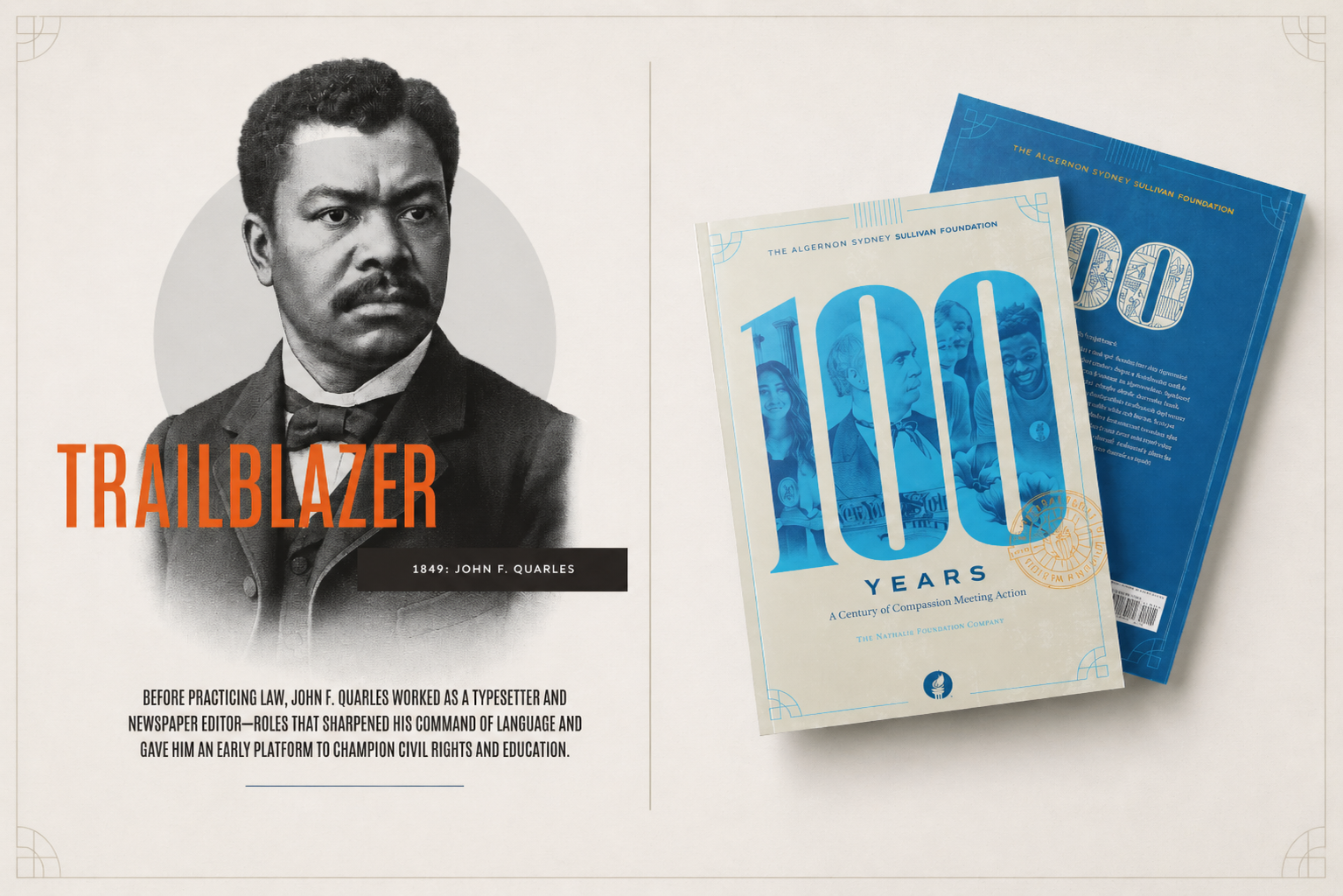
Excerpt from The Sullivan Story
Editor’s note: The following is an excerpt from The Sullivan Story, a publication of The Algernon Sydney Sullivan Foundation. It is reprinted here by the Foundation as part of its continuing effort to share stories from the Sullivan legacy of service, character, education and justice.
Championing New York’s First Black Member of the Bar
During the antebellum era in the American South, the lives of enslaved people were shaped by constant uncertainty and vulnerability. That instability intensified dramatically upon the death of a slaveholder. When a master died, those enslaved were often treated as property to be divided or liquidated—sold off to settle debts, handed down to heirs, or auctioned away to strangers. Families were routinely torn apart. Friends were scattered. The future became even more uncertain, governed by the whims of courts and surviving relatives. It was a moment of peril, not promise.
John F. Quarles, enslaved in Georgia, was unusually fortunate under such tragic circumstances. When his enslaver passed away, Quarles was inherited by the widow of the estate. Against the law and in defiance of social norms, she taught him to read and write—an act of quiet rebellion that would fundamentally alter the trajectory of his life. Literacy opened a door that slavery had tried to keep shut.
Following the Civil War, Quarles charted a path marked by extraordinary achievement and historic “firsts.” In 1870, he enrolled at Westminster College in Pennsylvania, becoming one of its first African American graduates. His academic success there paved the way for enrollment at Howard University’s newly established law school. Quarles graduated in its inaugural class—joining the foundation of a legal institution that would later produce trailblazers like Thurgood Marshall and Spottswood Robinson. Upon returning to Georgia, he became the first African American admitted to the state bar, breaking ground in a region still grappling with the legacy of slavery and the realities of Reconstruction.
Quarles’ growing reputation soon led to a diplomatic appointment. The U.S. State Department assigned him to the consulate in Spain, first in Minorca—a Mediterranean island—and later in the bustling coastal municipality of Málaga. It was during his time in Málaga that Quarles met and married his wife. Their life abroad was marked by cultural diplomacy, personal growth, and the beginnings of a global perspective that few Black Americans of the era had access to.
But Quarles had unfinished ambitions. He and his wife returned to the United States, setting their sights on New York City—a hub of legal, political, and cultural transformation. Quarles intended to establish a law practice there, but he first needed admission to the New York Bar. That process required the endorsement of a respected member of the legal community. For that, Quarles turned to Algernon Sydney Sullivan.
On May 10, 1880, Sullivan submitted a letter on Quarles’ behalf to the Supreme Court of the City of New York. It was a thoughtful and deliberate gesture. After outlining Quarles’ credentials, Sullivan departed from standard procedure to emphasize the significance of the moment:
“Although such motions are usually pro forma, for special reasons I depart a little from that custom. Mr. Quarles is a colored man born a slave, and the first of his race who, within my knowledge, will have become a member of the bar in the City of New York. I welcome Mr. Quarles in advance to his full equality in the franchise of the profession, and I assure him that his entrance to its ranks is observed by the bar with cordial and respectful interest and most graceful good wishes.”
With Sullivan’s endorsement and on the strength of his own accomplishments, John F. Quarles was admitted to the New York Bar. In doing so, he became not only a respected legal professional but also symbol of perseverance, progress, and the expanding possibilities for African Americans in post-Reconstruction America.
From bondage to the bar, from a Georgia plantation to a Spanish consulate and the courtrooms of New York City, Quarles’ story is one of transformation, quiet courage, and a deep belief in the power of education, justice, and opportunity.
Back to all News items.