
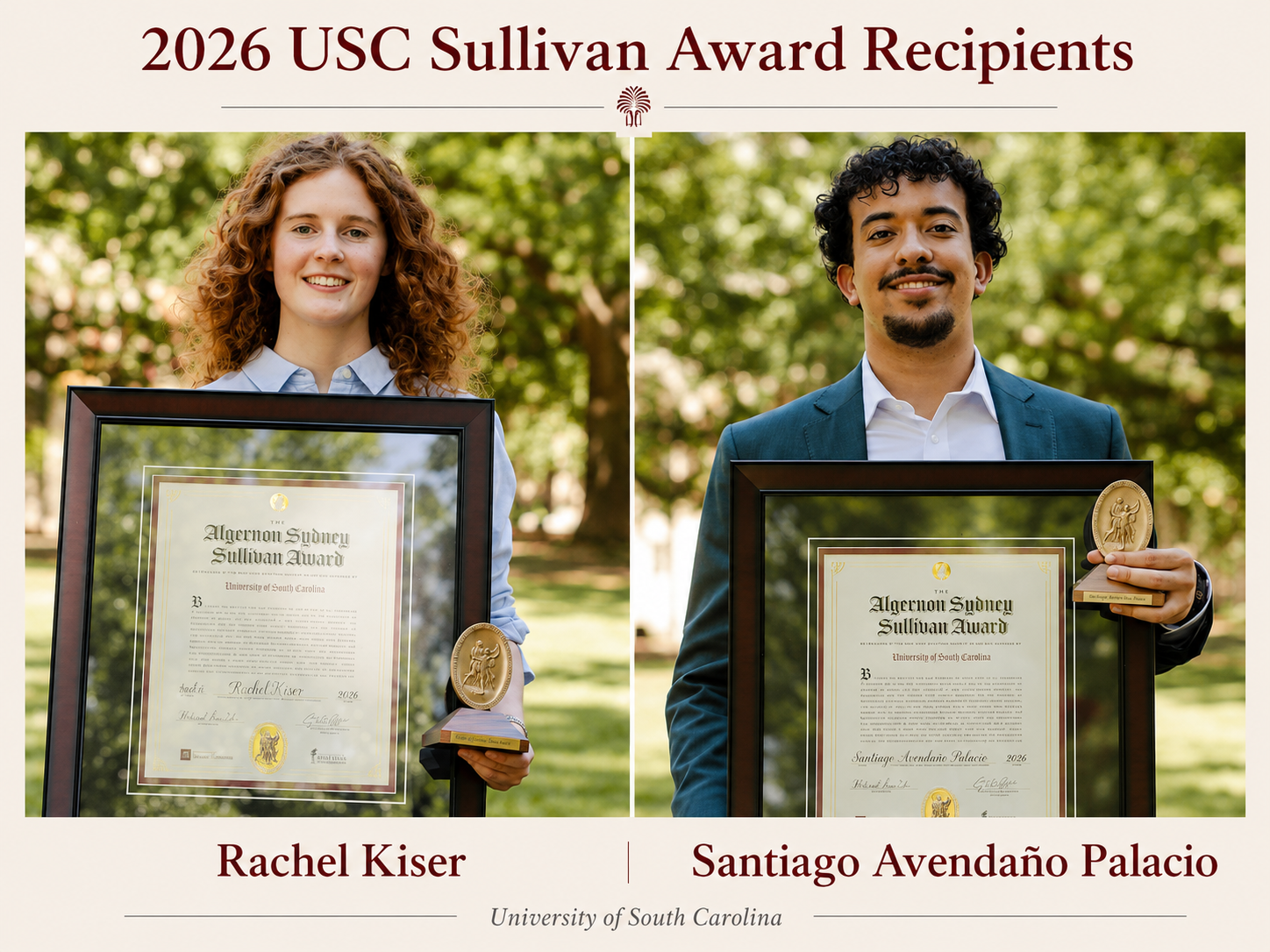
As the University of South Carolina celebrated 100 years of presenting the Algernon Sydney Sullivan Award, the centennial year also brought the tradition into the present through two graduating students whose work reflects the award’s highest ideals.
Rachel Kiser and Santiago Avendaño Palacio were named USC’s 2026 student recipients of the Algernon Sydney Sullivan Award, the university’s highest student honor. Their recognition came during a week when USC was looking back on a century of honoring character and service, while also asking what kind of students and leaders will carry the Sullivan tradition into the next century.
Kiser and Avendaño Palacio answer that question in different but complementary ways.
One has pursued scientific discovery while teaching and inspiring others. The other has turned leadership, advocacy, language access, and public health engagement into a sustained commitment to campus and community. Both have used their education not simply to advance themselves, but to make knowledge, opportunity, and care more available to others.
In a centennial year, their stories remind the Sullivan network why the award continues to matter.
Rachel Kiser: Science, Curiosity, and the Work of Teaching Others
Rachel Kiser’s path toward research and service began, in a way, in her backyard.
As a child in Charlotte, North Carolina, she spent time catching lizards and asking questions about the living world around her. What began as childhood curiosity eventually became a serious academic and scientific calling.
“My fascination for how life behaves and functions was channeled into exploring the world of biology around me as I knew it,” Kiser said. “My job as a young lizard-hunter required me to question the world around me, and I have continued my same curious perspective.”
At USC, Kiser turned that curiosity into rigorous academic work as a biochemistry and molecular biology major in the McCausland College of Arts and Sciences and a student in the South Carolina Honors College. Her research with faculty member Lydia Matesic focused on how overexposure to certain proteins has been linked to heart failure. Supported in part by an Honors College Research Grant, that work helped her contribute to a deeper understanding of human heart health and the development of pharmaceutical approaches focused on protein interactions in the body.
Kiser also broadened her research experience through internships with the National Institute on Drug Abuse, where she studied how negative experiences can shape addictive behaviors, and with Boehringer Ingelheim Pharmaceuticals, where she helped research disease progression related to Crohn’s disease and pulmonary fibrosis.
Her scientific work alone would be noteworthy. But the Sullivan Award recognizes more than academic achievement. It honors lives shaped by character, service, and concern for others. Kiser’s USC experience reflects that wider calling.
She has served as a supplemental instructor through the Student Success Center, helping other students in organic chemistry and calculus. She has also volunteered with the Chemistry Outreach Program, led by Linda Shimizu, traveling to elementary, middle, and high schools to help younger students understand the importance and possibilities of chemistry.
“The most rewarding element of my education is using my knowledge to improve the success of others,” Kiser said.
That sentence helps explain why her recognition as a Sullivan Award recipient is so fitting. Kiser has not treated knowledge as something to be held apart from others. She has used it to support classmates, encourage younger students, and advance ethical scientific literacy.
“Although organic chemistry has an intimidating reputation, I teach with passion to foster a love for the subject with its unique and prevalent applications in all aspects of our lives,” she said. “Both roles have had a significant influence in driving my future career path towards professorship, to continue serving students in their academic pathways and motivating their love for chemistry.”
Kiser will graduate in May and plans to pursue a doctorate in organic chemistry, focusing on drug synthesis and development with the hope of improving disease treatment. Her next step continues the pattern that defined her undergraduate years: learning deeply, asking hard questions, and using knowledge in service to others.
“My time at the University of South Carolina has not only provided me with a platform to succeed academically and in research settings,” Kiser said, “but has also allowed me to extend that academic success to others and has encouraged the spread of ethical scientific literacy across the country.”
Santiago Avendaño Palacio: Leadership Rooted in Dignity, Advocacy, and Community
For Santiago Avendaño Palacio, leadership and service are inseparable.
A senior from Greenville, South Carolina, in USC’s Darla Moore School of Business, Avendaño Palacio has built a record of campus leadership, research engagement, public health work, translation service, and community advocacy. His story reflects a central Sullivan idea: leadership is measured not by title alone, but by what one helps make possible for others.
“At the University of South Carolina,” he said, “I was given the opportunity and trust to turn that responsibility into meaningful service for both the campus and the greater Columbia community.”
Avendaño Palacio co-founded USC’s chapter of the Association of Latino Professionals for America and served in leadership roles for Phi Iota Alpha and Phi Delta Epsilon International Medical Fraternity. As academic development chair and later president of Phi Iota Alpha, a nationally recognized Latino fraternity, he led academic and professional workshops, supported younger members, and expanded philanthropic partnerships in the community.
“By prioritizing academic support, professional development, and leadership preparation I worked to ensure younger members were equipped to serve others and lead with intention,” he said. “Through this role I learned that leadership is measured not by recognition but by what continues after you step away.”
That understanding of leadership runs throughout his USC experience.
As a senior research assistant in the Bilingual Reading Difficulty Identification lab, Avendaño Palacio helped support research focused on child health, learning outcomes, preventative intervention, multilingualism, and Spanish-English speaking children and families. He also worked with the Arnold School of Public Health’s childhood obesity initiative and co-founded Exercise is Medicine, an organization focused on the importance of physical activity and health.
His service has also taken him into direct support roles with people navigating difficult systems. Avendaño Palacio served as a translator for the Domestic Violence Clinic at the Joseph F. Rice School of Law and at the Good Samaritan Clinic, helping non-English speakers access legal and medical support.
“Supporting clients through interpretation and legal preparation reinforced that service is not abstract,” he said, “but deeply personal and rooted in dignity, trust and presence.”
That insight speaks directly to the Sullivan tradition. The award honors not only achievement, but the kind of character that recognizes the humanity of others and responds with care. Avendaño Palacio’s work has often placed him at the point where language, health, justice, and access meet. His service has helped make institutions more reachable for people who might otherwise be left outside them.
He will graduate in May with a degree in international business, but his USC story suggests that whatever path he follows will continue to include service, advocacy, and community responsibility.
“My time at the University of South Carolina reflects a sustained commitment to serving and enriching both the campus and the Columbia community through leadership, advocacy and scholarship,” he said.
He added, “USC taught me to listen, to act with purpose and carry responsibility beyond myself. I will continue to use these lessons to advocate for access, equity and dignity in my future career and community involvement.”
Source information and student quotes were drawn in part from University of South Carolina profiles of the 2026 Sullivan Award recipients, written by Collyn Taylor.
Back to all News items.