
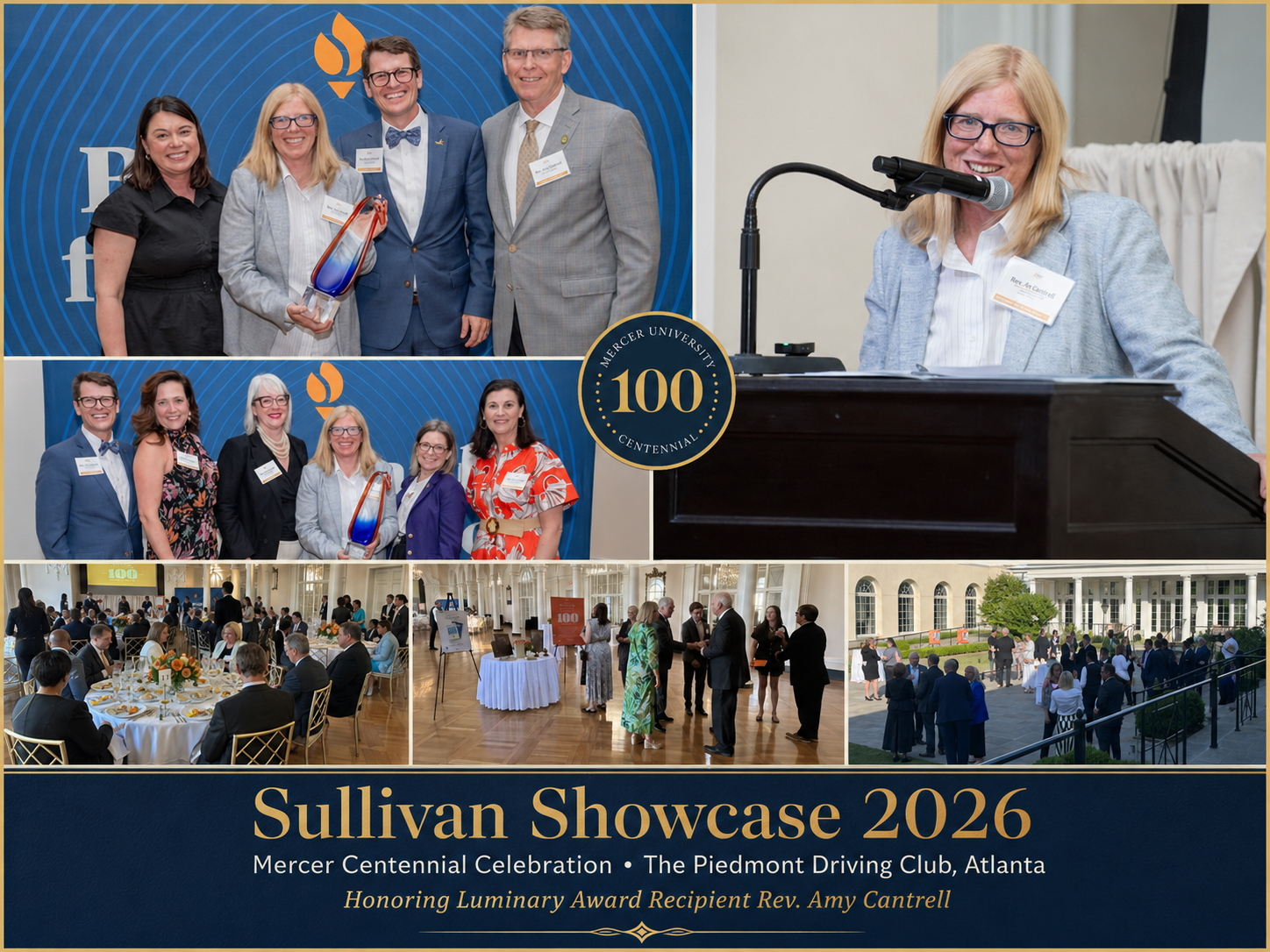
The April 10 Sullivan Showcase in Atlanta was built around a centennial, but its most memorable moment may have been the reminder that the work being honored is still alive, urgent, and deeply human.
The evening marked 100 years of Mercer University presenting the Sullivan Award, a tradition that has connected generations of Mercer students and leaders to The Algernon Sydney Sullivan Foundation’s enduring belief in character, service, and leadership shaped by responsibility to others. The Showcase was held at The Piedmont Driving Club in Midtown Atlanta, one of the South’s historic private clubs and a setting that gave the evening a sense of occasion before the program even began. The Showcase brought together alumni, campus leaders, friends of the Foundation, and representatives from several regional partner schools to recognize a century of service at Mercer and to look toward the work still ahead.
That future came into clear view through the recognition of Reverend Amy Cantrell, a 1994 Sullivan Award recipient from Converse University and the 2026 recipient of the Sullivan Luminary Award. Cantrell is the co-director of BeLoved Asheville, a community-rooted organization working on housing insecurity, food access, economic justice, crisis response, and long-term community care. BeLoved describes itself as an intentional, intersectional community of people from the streets and margins who love each other and work together to create solutions to homelessness, poverty, and racism.
In honoring Cantrell during Mercer’s centennial celebration, the Foundation connected two essential pieces of the Sullivan story: the institutional legacy of a school that has carried the award for a century and the living witness of an award recipient who has continued to turn service into action across a lifetime. Cantrell’s work also gave the evening a deeply practical expression of the Sullivan ideal. Her life shows what it means to cross boundaries, build relationships, and turn recognition into responsibility.
The setting helped tell that story as well. Guests gathered in a grand, light-filled hall framed by tall arched windows, carved columns, ornate chandeliers, and polished parquet floors. Large round tables dressed in white linens, floral centerpieces, and centennial signage gave the space a formal and celebratory feeling. Just outside, the courtyard offered a place for conversation, with guests gathering along the terrace, steps, and garden edge before returning inside for the dinner and program.
A Centennial Evening with Mercer
The 2026 Sullivan Showcase was more than an annual gathering. It was a centennial pause of sorts in a relationship that reaches back to Mercer’s earliest years of presenting the Sullivan Award. Each year, the award has recognized students and leaders whose lives point toward service above self. Over time, those annual recognitions become more than ceremonies. They become a record of what a university chooses to honor and what it hopes its students will carry into the world.
Mercer’s centennial gave the Foundation an opportunity to look back with gratitude. It also gave the evening a larger purpose. The Showcase did not simply celebrate a hundred years already completed. It asked what a century of Sullivan recognition should mean now, at a time when students, faculty, alumni, and community leaders are being called to address problems that require both courage and compassion.
The program honored Mercer University and welcomed regional host schools whose presence reflected the larger Sullivan network, including Brenau University, Converse University, Oglethorpe University, Sewanee, and Wesleyan College. In that sense, the evening belonged to Mercer, but it also belonged to the wider community of institutions that continue to invest in students and alumni committed to purposeful leadership.
Steve McDavid, president of The Algernon Sydney Sullivan Foundation, said the centennial moment was meaningful because it brought history and present-day service together in one room.
“Mercer’s 100-year Sullivan tradition reminds us that service is not something a college simply names once a year,” McDavid said. “It’s something a campus teaches, honors, and hands forward. Amy Cantrell’s life and work gave the evening its clearest focus. She showed us what happens when a Sullivan Award recipient keeps saying yes to people, to community, and to the hard, necessary work of loving humanity in practical ways.”
An Atlanta Setting with a History of Its Own
The Piedmont Driving Club brought its own history to the evening. Founded in 1887 as the Gentlemen’s Driving Club, the Club’s name came from the practice of “driving” horses and carriages on the grounds. Located today at 1215 Piedmont Avenue NE, between Piedmont Park and the Atlanta Botanical Garden, the Main Clubhouse sits in one of Atlanta’s most recognizable civic and cultural corridors.
That history made it a fitting place to mark Mercer’s Sullivan centennial. The Club belongs to post-Reconstruction Atlanta, a period when the city was reshaping itself socially, commercially, and architecturally. Its origins in carriage driving and private social gatherings connect it to an older Atlanta, while its present-day event spaces have become part of the city’s ceremonial life. For an evening devoted to memory, legacy, and the next century of service, the location gave the Showcase a sense of continuity. It placed a 100-year Sullivan tradition inside a room that also carries the weight and elegance of Atlanta history. The result was an event that felt both intimate and historic, anchored by Mercer’s centennial and widened by the presence of the larger Sullivan family.
The Luminary Award as a Living Link
The Sullivan Luminary Award recognizes a past Sullivan Award recipient whose life continues to reflect the values the award was created to honor. At the Showcase, that recognition became one of the evening’s most powerful reminders that the Sullivan Award is not meant to be a final compliment. It is often the beginning of a much longer story.
Cantrell received the Sullivan Award at Converse University in 1994. In the years since, she has built a life of service that is both practical and deeply relational. Through BeLoved Asheville, she has helped create a model of community care that works alongside people impacted by poverty, racism, housing insecurity, food insecurity, and the long-term effects of crisis and displacement.
Her work is not distant. It is close to the ground. It is rooted in neighborhoods, relationships, meals, homes, mutual support, and the belief that people closest to a problem must also be part of creating the solution. BeLoved Asheville has become known for deeply affordable housing work, food and health equity efforts, community health work, and grassroots crisis response, including its relief and rebuilding efforts after Hurricane Helene devastated parts of western North Carolina in 2024.
The community’s work has included the Homeless Voice Project, the Rise Up Studio artists collective and Street Musicians Guild, a sanctuary in the New Sanctuary movement, the Elders Free Farmers Market, community gardens, a homeless Street Medic Team, and campaigns focused on housing, food justice, economic justice, and the uprooting of systemic racism. That breadth of work helps explain why Cantrell’s Luminary Award was not simply a recognition of one program or one accomplishment. It was a recognition of a life organized around community, and the belief that people pushed to the margins must be central to the work of repair.
For the Foundation, that kind of service is exactly why the Luminary Award exists. It gives today’s students and alumni a model of what a Sullivan life can become after the ceremony ends and the medallion is put away. It shows that service above self is not a slogan. It is a practice.
A Moment That Moved the Room
Cantrell was surrounded at the Showcase by members of her Converse family, and the award was presented by Julie Gehrki, the 2025 Sullivan Luminary Award recipient and president of the Walmart Foundation. The continuity of the moment mattered. One Luminary recipient presented the award to another. One generation of recognized service honored the next. The room saw not only an individual achievement, but a chain of example.
When Cantrell accepted the award, her words carried the room beyond the formality of recognition and into the deeper meaning of the evening.
“Together, we are hundreds of lights igniting change,” Cantrell said. “I encourage us all, don’t stop, never stop loving humanity, being light, and walking the path to true greatness together. Everyone can be great, because everyone can serve!”
The response was emotional because the words matched the life being honored. Cantrell did not speak as someone who had merely advocated for service. She spoke as someone who had practiced it through years of presence with people often unseen by institutions and systems.
Her message also returned the evening to the heart of the Sullivan tradition. The Foundation’s work has always depended on the belief that greatness is not measured by position alone, but by the willingness to use one’s gifts for others. Cantrell’s words placed that belief in the language of light, humanity, and shared responsibility.
That message also echoed the way Cantrell has described the work of BeLoved Asheville. “A mentor taught me that love requires proximity,” Cantrell has said. “We must cross boundaries in order to begin to build community. There are places that we just don’t go and people we just don’t know. This, I believe, is how injustice thrives. We can create healing through relationships. This is what Dr. King called the beloved community.”
Those words help explain why her Luminary Award resonated so strongly during the Showcase. Cantrell’s work is not built around distant service to people in need. It is built around shared life, shared struggle, and the conviction that love becomes real when people are willing to move closer to one another.
A Converse Story within a Mercer Celebration
One of the strengths of the Showcase was the way it allowed several institutional stories to meet. Mercer’s centennial was the frame. Converse University was present through Cantrell’s own Sullivan journey. The broader Sullivan network was present through the partner schools, alumni, supporters, and friends who gathered in Atlanta.
Cantrell has often credited her time at Converse with shaping her commitment to service and justice. In a Converse University profile, she said her passion was spurred by her time at Converse and described a college trip to New York City as pivotal in her life. There, she built relationships with people experiencing homelessness and began to take a deeper look at the systemic issues that would later shape her work.
That early experience helps explain why Cantrell’s recognition at Mercer’s centennial was so fitting. The Sullivan Award is given on individual campuses, but its influence is not meant to remain there. It follows recipients into cities, churches, neighborhoods, nonprofits, schools, businesses, public service, and ordinary places where character is tested and service becomes concrete.
Cantrell’s life reflects that movement from campus recognition to community commitment. What began as a student’s growing awareness became a lifetime of building community with people most affected by inequity and hardship. Her story also reflects one of the deepest hopes of the Sullivan network: that students recognized for character and service will continue growing into leaders who do not look away from suffering, but move toward it with humility, imagination, and love.
A Century Remembered, a Future Invited
Every centennial carries the temptation to become a closing chapter. The Showcase resisted that temptation. Mercer’s 100-year Sullivan tradition was honored not as a finished story, but as a living inheritance. The evening asked guests to remember what has lasted, recognize the people who have carried it, and help extend the work into the next century.
Cantrell’s Luminary Award helped make that invitation visible. In her life and words, she reminded the room that service is not limited to a particular class of people, profession, or stage of life. It is available to anyone willing to pay attention, draw near, and act with courage and care.
That is why her recognition belonged at the center of the Mercer centennial Showcase. Mercer’s first century with the Sullivan Award tells the story of an institution that has continued to honor service. Amy Cantrell’s life tells the story of what can happen when that honor becomes a calling.
A hundred years after Mercer began presenting the Sullivan Award, the question remains alive. Who will carry this tradition forward? Who will turn recognition into responsibility? Who will become, in Cantrell’s words, one of the lights igniting change?
Back to all News items.