
The first thing Ignite asks of students
Before Ignite teaches students to pitch an idea, map a problem, or clarify a calling, it asks for something more basic and more difficult: willingness. Without that, the weekend becomes another well-meant event full of decent advice that never quite lands. With it, the whole retreat changes.
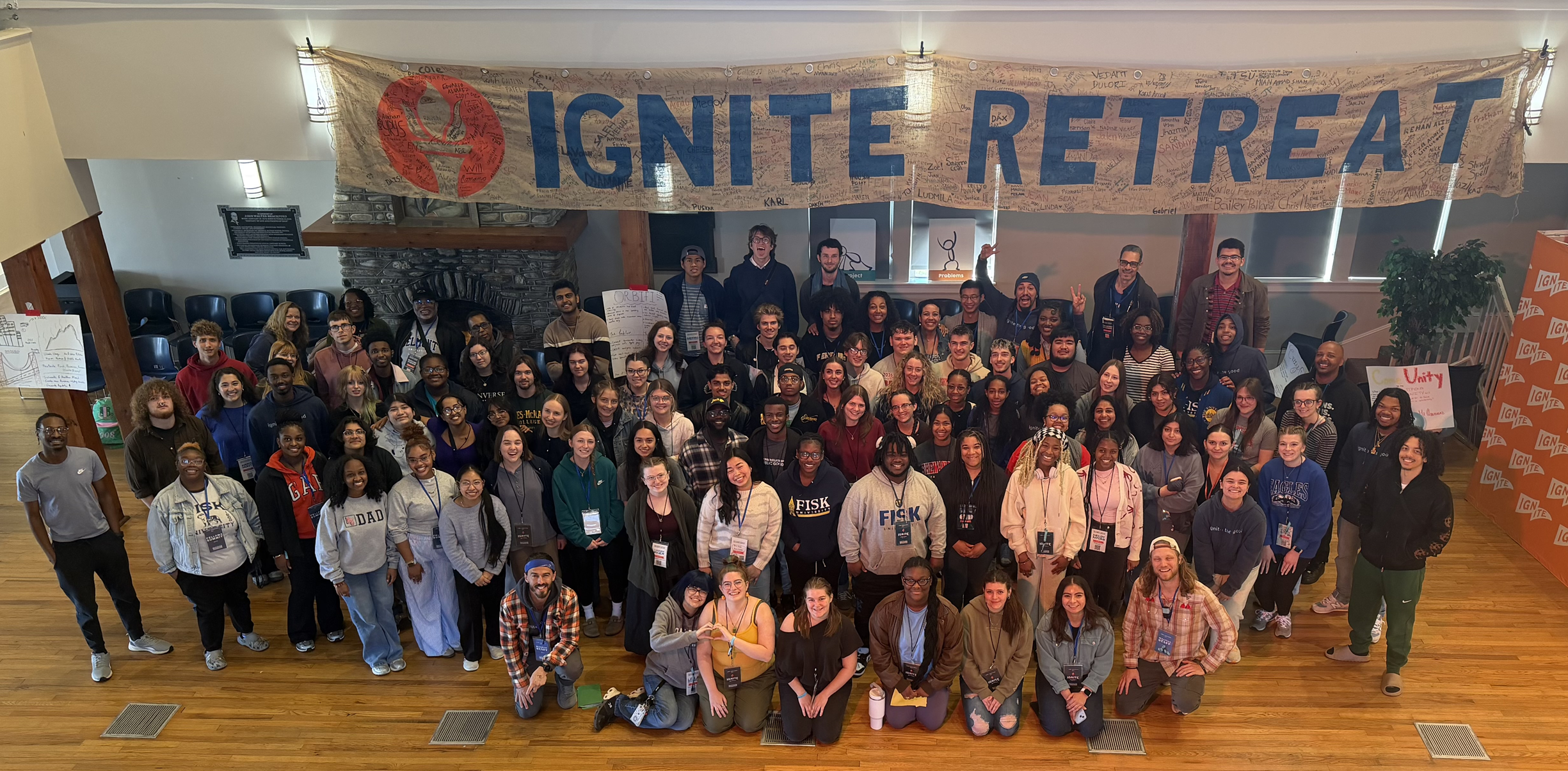
This spring’s Ignite Retreat at Lake Junaluska seems to have benefited from that willingness from the moment students arrived. Josh Nadzam, the coordinator of the Ignite event said, “What stood out most is how eager and willing the students were to engage.” He added that they “opened up to us and each other quite quickly and were invested in making connections, learning, and being present.” Those are not small observations. They explain why a retreat can move beyond good logistics and become a place where people actually risk honesty.
That is one reason Ignite still matters so much in the Sullivan pathway. The Foundation’s own website description is straightforward: in two days, students gain clarity, confidence, and community to spark positive change. Those are simple words, but they are not small ambitions. Clarity matters because many students know they want a meaningful life before they know what that should look like. Confidence matters because purpose without nerve rarely becomes action. Community matters because very few students sustain difficult work in isolation. Ignite does not promise finished answers. It promises a more usable beginning.
What Ignite is, and what it is not
It helps to say clearly what Ignite Retreat is for, especially for readers who are newer to Sullivan programming. Ignite is not a long-term Fellows cohort, not a summer internship, and not merely a motivational weekend. It is an on-ramp, a generous but serious entry point for students who feel some combination of concern, curiosity, conviction, and unfinished possibility.
The retreat is intentionally structured to meet students in different places. There are three student tracks: Personal, Problem, and Project. The Personal track serves students who are trying to better understand their gifts, interests, and direction. The Problem track is for students who are already animated by a particular issue and want practical tools to move toward solutions. The Project track serves those who already have a specific initiative, venture, or concrete idea that needs sharpening, sequencing, and support.
That framework is one of the reasons Ignite has remained useful over time. It does not force everyone into the same starting line. It acknowledges that some students arrive with only a strong uneasiness, a sense that their life should count for something more. Others arrive already trying to solve something. Still others have moved into early execution and need better structure. By making room for all three, Ignite avoids a common mistake of student leadership programming, the assumption that every participant needs the same lesson at the same moment.
The weekend’s real atmosphere
Much of what makes Ignite effective is invisible in a brochure. It is the atmosphere around the content. It is the way a conversation continues in a hallway after a workshop ends. It is the moment a student hears another student from another campus describe the same fear, the same ambition, or the same half-formed idea and realizes, perhaps for the first time, that thoughtful action is something shared.
That atmosphere was unusually strong this spring. Nadzam said the students were invested in learning and connection from the outset, which meant facilitators did not have to drag participation out of the room. “It was very encouraging,” he said, and the phrase feels almost understated in light of the way he described the group’s openness. The best retreat environments are not created by volume alone. They are created when students decide, for a weekend, not to hide behind the usual detachment.
This is also where the broader Sullivan environment matters. Students at Ignite are not gathered in a vacuum. The weekend unfolds alongside Fellows returning for deeper formation and faculty participants engaged in their own professional reflection. That larger ecology reinforces the message that purposeful leadership and service-oriented work are not side interests. They are part of a living community with a history, a vocabulary, and adults who take them seriously.
What was new this spring
Programs reveal their character not only by what they proclaim, but by what they adjust when participants speak. One of the clearest refinements this spring was the continued growth of the now well-loved “chill room.” Nadzam explained the reasoning with admirable simplicity: “Saturday night typically concludes with a fun dance party. However, we got some feedback from students who shared how they’d like an opportunity to continue socializing, but dancing with loud music wasn’t their thing.” Instead of treating that as resistance, the team made room for another kind of belonging.
The result is a quieter room with games, couches, and relaxed conversation, a space where students can keep building friendships in a different register. Nadzam said it has been a big hit. That response says something important. Good student programming does not force every participant into a single acceptable mode of engagement. It expands the range of belonging. Some students will always process joy outwardly and visibly. Others need a less crowded place to settle into real conversation. By making room for both, Ignite becomes more hospitable without losing its energy.
What looks like a logistical detail is really an expression of philosophy. Sullivan has often talked about clarity, confidence, and community. The chill room is what community looks like when staff remember that personality differs, comfort differs, and connection often deepens when students can choose the environment that best helps them stay open.
The people who make Ignite possible
One of the more attractive things about Ignite is that it still depends on people, not just systems. Coaches, facilitators, campus partners, and staff all shape the feel of the weekend. Nadzam himself represents one form of continuity. He is someone who moved from participant to coach to facilitator, and now into a leadership role central to Ignite’s design and execution. That kind of progression matters because it keeps the program close to student reality. People who have been formed by the experience are often well positioned to protect what is most valuable in it.
Nadzam was also quick to highlight a group that can be overlooked in public storytelling, the faculty and staff members who travel with students, surrender their weekends, and make attendance possible. “We are so grateful for the faculty and staff who make it possible for their students to attend,” he said. “So many of them give up their weekends to drive down with the students and serve as their chaperone. We are endlessly appreciative of their effort in this.”
For alumni and supporters, this is an important part of the story. Ignite is never only about what happens in the session room. It is also about the web of support that makes participation possible. Students often attend because someone on campus encouraged them, found funding, drove a van, or believed the trip would matter. The weekend is visible. The scaffolding behind it is not. But both deserve recognition.
Where Ignite is headed next
One of the strongest signs of health in a program is that its leaders are already thinking about what happens between one retreat and the next. Nadzam said the team is “continuously aiming to engage students between each retreat, as well as involve former students in future events.” That could mean former participants returning as coaches, assistants, photographers, or in other support roles. It could also mean a deeper follow-up relationship with pitch contest winners, not simply congratulating them and moving on.
The team also wants to continue supporting students connected to the pitch process and to offer mini-Ignite events in condensed formats, sometimes over a day and sometimes as a single workshop. That kind of outward movement may prove increasingly important as the Foundation thinks about capacity. Not every useful Sullivan experience has to wait for the next large weekend gathering. Smaller, regional, or campus-based experiences can widen access while keeping the programming close to the places where students actually live and work.
The Foundation has fall Sullivan Weekend dates on the calendar for October 9 to 11, 2026, and it continues to signal regional opportunities as well. That means Ignite is not becoming less focused. It is becoming more available.
Why students, alumni, and underwriters should pay attention
The easiest way to misunderstand Ignite Retreat is to think of it as an emotional experience with little practical consequence. In reality, the weekend often matters because it makes concern usable. A student arrives unable to articulate what exactly is pulling at them. By Sunday, that student may not have a complete plan, but they may finally have a question worth pursuing, a first next step, a new collaborator, or the confidence to stop waiting for permission.
That is not trivial. Many students learn how to look sure of themselves, but are unsure how to move forward when they do not have all the answers. Ignite helps them begin while they are still unfinished. It gives them a place to practice small courage in public, with coaches and peers close enough to help but not so close that the student never has to own the work.
For alumni and supporters, this is one of the most compelling reasons to invest. A funded ticket does not purchase inspiration. It helps make possible the kind of weekend where a student starts believing that a life of contribution can be built, not merely admired. And because Ignite often functions as a threshold into longer Sullivan engagement, the return is not confined to one weekend. It can continue into Fellows, Service Corps, the Impact Prize, or simply into a more service-oriented and purposeful life back on campus.
That is why Ignite still deserves close attention. It is not flashy. Its best outcomes are quieter. A student who knows one step to take. A student who has found language for purpose. A student who leaves with community instead of private restlessness. That is how the work begins. It is also how a meaningful future often begins.
Back to all News items.