
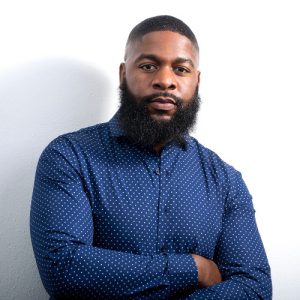
Deterrian L. “DT” Shackelford does not begin his leadership story with a trophy or a scholarship or a depth chart. He begins with a smell.
He is eight years old, and his mother is gathering her three children for Christmas morning. They are not headed toward the sights and sounds of wrapping paper being gleefully torn from holiday morning gifts. They are headed somewhere else, carrying food to a homeless shelter. DT remembers it in the way memory often comes to us later in life, not in words but as a sensory detail: “Instead of big, bright gifts up under the tree, it was me smelling macaroni and ham to go and take to those who were less fortunate.” In a child’s world, where Christmas is supposed to be proof that you are loved, his mother offered something more valuable. She showed they were loved enough to be asked to love others. DT says that practice, repeated from ages eight to fourteen, is one half of how he learned to lead.
The other half begins with a towel.
DT is a man of faith, and he returns often to the moment in the Gospels when Jesus, after supper, takes a towel and washes feet. DT says it plainly, the way a person says something he’s said many times before, but its meaning, to him, has never diminished. “After a meal, the last thing you want is to kneel and wash anybody’s feet, explained Shackelford.” He treats this act not as a story to admire but as a daily assignment. “Foundationally, I try to say to myself each and every day, how am I carrying a towel to be able to wipe the feet of those who come into my presence.” Then, he clarifies what he means by “towel,” because he is not speaking in poetry so much as in practice. “If there’s a tear I need to wipe. If there’s a hug I need to give. If there’s some wisdom that I need to give somebody else, and sometimes it’s just my ear, but for me that’s carrying a towel.”
Then he says the line that makes you understand he means it. “Hopefully, by the time I get done with this life, my towel won’t be white, it’ll be brown.”
In the Algernon Sydney Sullivan Foundation’s work with emerging leaders, DT’s brown towel is not merely a metaphor. It is a compressed theory of ARC, the leadership model at the center of the Sullivan Fellows Program: Agency, Relationship, Contribution. ARC suggests that lasting service begins in the interior life, grows outward through connection, and culminates in tangible change. Dr. Jody Holland, who helped design the Fellows Program and teaches the public policy and leadership components of it, describes the Foundation’s purpose with a kind of clarity that can only come from years of working close to students who want to do good but are not sure yet how to do it well. “The Sullivan Foundation has long celebrated selfless leaders,” Holland notes. “This program expands on that by outfitting students with leadership tools applicable anywhere.”
DT’s leadership story is, in many ways, a field guide to those tools. Not because he read them in a manual, but because life pressed them into him.
He arrived at the University of Mississippi from Decatur, Alabama, became a starting linebacker for Ole Miss, and accumulated the kind of off-the-field record that make the athletic department PR department’s job a breeze. He was a five-time SEC Academic Honor Roll selection, a two-time semifinalist for the National Football Foundation Scholar-Athlete Award, and a two-time member of the SEC Community Service Team. He became captain of the Allstate AFCA Good Works Team and, later, the 2015 Wuerffel Trophy winner, a national honor for college football players who combine athletics, academics, and community service. His football team, in 2014, led the nation in scoring defense. He was also, eventually, recognized with the Algernon Sydney Sullivan Award at Ole Miss, the University’s highest service honor, and he was named the 22nd recipient of the Chucky Mullins Courage Award, becoming the first junior to receive it and earning the right to wear Mullins’ No. 38.
Awards are a strange currency. They can buy visibility, but they can also tempt a person into thinking the point is the medal itself. DT talks about honors the way he talks about most things, as evidence of a deeper obligation. He does not sound like a man who believes his life is a performance. He sounds like a man who believes his life is a stewardship.
To understand why, you have to understand how DT defines strength.
“I think that the true strength of a home is the foundation,” he says. “If you really want to know the true value of a home, throw a storm at it.” He smiles at the irony. Nobody praises foundations. People praise paint and doors and “the pretty things.” But the foundation is what decides whether the house remains standing.
This is where ARC begins, in the part of a person that is not glamorous. The Sullivan Fellows call it Agency, the capacity to govern yourself so that you can serve others without being swallowed by ego, fear, or chaos. Holland puts it this way when she explains the first year of the Fellows Program: “This first step allows one to see leadership from within before tackling external challenges.” DT’s story supplies the lived version of that sentence.
Agency, for DT, was not discovered in a seminar room. It was forged in opposition.
“It has been opposition that has confirmed my calling,” he says, pausing just long enough to acknowledge that this is not the answer people expect. He has spent enough time around leadership culture to know what the typical script sounds like: the calling arrives, doors open, plans work, and the hero walks through a well-lit and straight pathway toward success.
DT laughs at that pathway. “If I’m called to be a CEO, surely it’s supposed to work like the way we drew it up on the whiteboard,” he says. “Never fails that there’s a yellow flag that’s going to get thrown.” His mind goes immediately to football, because football, for him, is not only a sport but also a language for consequences. Someone jumps offside. Someone gets injured. Something breaks. If you stop at the first sign of resistance, then you never discover what you were actually built to do.
The insight is both practical and spiritual. DT’s work has included leadership roles in multiple organizations, including serving as Chief Director of Operations for the Male Mogul Initiative in Chicago, a role focused on developing programming and curriculum for young men in under-resourced communities, and later serving as Co-Executive Director at Neighborhood Christian Centers in Decatur, Alabama, where he and his wife, Jhorden, helped lead an organization that provides wraparound services like job training, parenting classes, a food pantry, a clothes closet, youth leadership opportunities, and transitional housing. In each place, he says, opposition did not mean he was in the wrong location. It meant he was being shaped for the right one.
“Over the past, let’s just take the past five years,” he says, “I faced opposition, and in both spaces, I felt like that’s where God was leading me to, because there was opposition that was grooming me and weaknesses that I would have never faced if I would have only navigated towards my strengths.”
DT takes his weaknesses and opposition seriously, but he does not let these decide the outcome. He acknowledges how hard things are, then keeps moving forward anyway.
He has a set of sentences he uses when he teaches, the kind that sound like they were hammered out under real pressure rather than learned from a notebook. “You can’t conquer what you won’t confront,” he says. “You can’t defeat what you won’t define.” He is building an argument about character. Not the inspirational kind, but the whole kind. “Integrity,” he reminds you, comes from the root idea of wholeness. The question is not whether you can look whole. The question is whether you are whole when no one is watching.
In this sense, DT’s athletic life and his service life are not separate tracks. They are one training ground. He suffered multiple knee injuries at Ole Miss that threatened to derail his career and required him to return, repeatedly, through rehabilitation and uncertainty. He also kept showing up in places where he could have been excused from showing up: mentoring youth in Oxford, leading mission trips to Haiti and Panama, volunteering locally, and continuing to invest in people even when his own life was demanding a kind of inward triage.
Agency is the discipline of showing up anyway.
Relationship is what happens next, and this is where DT’s leadership becomes especially instructive for Fellows because he does not confuse relationship with comfort. He treats relationship as a moral skill.
DT speaks often about unity, but he is careful with the word. He has lived in enough contexts, from locker rooms to nonprofit boards to community partnerships, to understand that unity can become a weapon if it demands that people erase themselves. “Just because we’re unified don’t mean that I lose my distinction,” he says. It is a sentence that, espoused from a different mouth, might become a slogan that hides its meaning. Coming from DT, it is a warning and a promise. He is warning against a kind of unity that demands conformity. Where a group’s harmony comes at the cost of individual integrity. He is promising a better kind of unity, where people collaborate deeply while still being fully themselves.
The Sullivan Fellows Program’s second year focuses on relationships, networks, and the ability to build community ties. Holland describes the work as the “art of building relationships that empower,” a phrase that sounds simple until you realize what empowerment actually requires: listening, humility, patience, and the willingness to share credit. In DT’s story, relationships are rarely effortless or easy. They are earned.
One of his most vivid images comes from football, again, because football has given him an internal map of human emotion under pressure. He talks about what he calls the “dark tunnel,” the passage from the locker room to the field. It is a short space, but it holds a lot of psychology. In the locker room, you are surrounded by teammates and rituals and noise. On the field, you are surrounded by adrenaline and consequences. The tunnel is the in-between, and in-between is where doubt likes to live.
In that tunnel, you are not arguing with your opponent. You are arguing with yourself.
DT is describing, in athletic language, the interior transition that leadership often demands. You can believe in service and still be afraid of what it will cost. You can value people and still want control. You can speak about community and still protect your ego like it is a fragile heirloom. Relationship, in the ARC sense, requires crossing that tunnel. It requires entering rooms where you do not automatically belong and staying long enough to become trustworthy.
DT has practiced this kind of leadership in settings that are, by design, diverse and complicated. He describes co-leading a men’s Bible study group in Chicago where the room includes a range of backgrounds, beliefs, and identities. He mentions Catholics and Christians, Muslims and atheists, people who might not share the same assumptions about anything, but who are willing to gather and pursue growth together. The point of the group is not to smooth over difference. The point is to build a space where difference can be held without hostility.
When DT talks about relationship, he returns repeatedly to listening, not as a technique but as a discipline. Sometimes listening means hearing pain you cannot solve. Sometimes it means hearing criticism you would rather dismiss. Sometimes it means letting someone else’s idea take the spotlight because what you really want is the shared result.
There is a moment in the interview when he discusses leadership collaboration and conflict, and you can hear him resisting the temptation to portray himself as the hero of every room. He knows that leadership is a team sport. Not the shallow version, where everyone gets a trophy, but the deeper version, where you learn to submit your preferences to the mission, and where your ability to build trust determines whether the work survives.
Contribution is the third component of ARC, and it is the part that most people rush toward because it is visible and gets attention. But ARC insists that contribution is not stable unless it is supported by agency and relationship. DT’s life demonstrates this truth in a way that is both inspiring and sobering.
After Ole Miss, DT’s path took him into work that sits at the intersection of performance, development, and care. He served as a Major Gifts Officer at the University of Mississippi, focusing on relationships that supported student-athlete welfare and development, including funding for mental health and wellness resources and leadership initiatives. Later, in Chicago, he helped develop programming and curriculum for young men, focusing on personal and social development in under-resourced communities, pairing it with counseling and partnerships that offered holistic support. He also built his own work as an educational consultant and motivational speaker, delivering talks and workshops on resilience, performance optimization, and leadership, and consulting one-on-one with athletes and students as they navigated stress and identity.
Then he returned home.
There is something quietly circular about the fact that DT’s life brought him back to Decatur and to Neighborhood Christian Center, an organization he once attended as a child. It is the kind of story that, if you were writing fiction, would feel too neat. Life, though, sometimes delivers its symbolism overtly and without apology. The boy who learned service in a shelter now helps lead an organization serving families through food access, transitional housing, classes, and support systems meant to stabilize lives that have been destabilized.
Contribution, in DT’s view, is not dramatic. It is consistent. It is also not a personal brand. It is a community decision.
If you want to understand why DT’s awards matter, you have to understand how they fit into this ethic. The Sullivan Award and the Chucky Mullins Award are not decorations to him. They are confirmations of a way of living that began long before any ceremony.
The Sullivan Award honors “nobility of character” expressed through selfless service. DT received it in 2015 after years of visible, unflashy investment in others. The Chucky Mullins Courage Award carries a different kind of weight. Mullins, paralyzed during a 1989 game, became an emblem of courage and perseverance at Ole Miss. Wearing No. 38 is not merely symbolic. It is an expectation. It asks the wearer to represent courage in public, which is a difficult assignment for anyone, and especially for a young person still learning who he is.
DT’s response to that expectation is not to become a statue. It is to become a servant.
Near the end of our conversation, DT says something that reframes leadership in a way that Sullivan Fellows can carry into their own work. He is writing a book, and he talks about the last chapter as a message to readers who want a clean ending, a sense that if they just accomplish enough, they will finally feel finished.
He does not believe in finished. “Life is unfinished,” he says. The phrase lands with a particular gravity because it is the opposite of what high-achieving students are often trained to seek. They are trained to chase completion: the degree, the job, the acceptance, the credential, the accomplishment that will finally quiet the anxiety.
DT offers a different vision. You do not arrive at leadership. You practice it. You get better, and then you meet a new version of yourself that still needs refining. Your towel keeps getting dirty.
This is, in many ways, the deepest alignment between DT’s life and the Sullivan Fellows Program. Fellows are not being trained merely to collect leadership experiences. They are being equipped to become the kind of people who can sustain leadership over time, without burning out, without becoming cynical, without allowing achievement to replace character.
Holland describes the three-year progression of ARC as a developmental path: first the inner work of self-awareness and vision, then the outward work of relationships and community ties, then the culminating work of real-world problem-solving and changemaking projects. DT’s story maps onto that sequence, but it also complicates it, in a useful way. It shows that the stages are not boxes you check. They are habits you revisit. Agency is not a one-time discovery. Relationship is not a single network. Contribution is not one project. The work keeps moving.
If a Sullivan Fellow asked DT what to do next, he would not tell them to craft a brand. He would likely tell them to carry a towel.
That towel might look like sitting with someone who is grieving when you would rather offer quick advice. It might look like volunteering when your schedule is packed. It might look like being willing to learn from someone you do not naturally agree with. It might look like refusing to quit when opposition appears, and instead asking the harder question: what is this opposition trying to teach me about my weaknesses, my blind spots, my need for control, my fear of failing publicly.
DT’s leadership is not tidy. It is faithful. It offers Sullivan Fellows a clear, demanding invitation: if you want to lead, start where nobody applauds. Build the foundation. Walk through the tunnel. Carry the towel until it changes color.
Back to all News items.